Executive Summary
1.1 Introduction
This IEEE Education Society Strategic Plan is the result mainly of the work carried out by the Strategic Plan Committee (SPC) during the last two years, 2020-2021, with the last update during the first months of 2022. This documents aims to help the current and future leaders to be aligned in terms of strategy and operations and to begin a cycle of continuous improvement.
The process that has given rise to this document has been based on the following foundations:
-
All the process should be done in virtual environment due to the pandemic.
-
The IEEE TAB Society Review Committee (SRC) strongly recommended that the Society put specific actions and timelines and owners for these actions to implement the strategic plan and drive it towards success.
-
Do not start from scratch but take as a starting point and use of strategic actions developed by the SPC since 2014. Highlight, a series of Presidential Commitments proposed by President Meier in 2019 and the identification of stakeholders by the SPC in 2017.
-
Use the strategic framework of the TAB and the templates provided.
-
Ensure alignment with different strategic sources of the TAB.
-
Expedite obtaining a first round of proposals by allocating each officer the strategy proposal in their respective areas.
-
Provide a transparent environment based on Excel documents and forms through which all members of the SPC have been informed of the proposals and their development.
-
Search for consensus facilitating presentations and defense of the proponents of strategies and their subsequent discussion by all members. (4 SPC meetings between June 2020-up to now).
-
Set a limited period of time to obtain results that would allow the presentation of a draft plan during the SCRC Review.
1.2 Timeline
The work done by this Committee during the period June 2020 – June 2022 can be summarizes through the following milestones:
-
June, 2020 SPC Zoom Meeting. Orientation Session: SPC chair presented the main pillars to develop with the main purpose of having strategic plan finally approved by the Board and the possibility that it was included as an appendix to the all-society review document.
-
July, 2020: Submission of the SPC Meeting minutes (meeting June 22, 2020) to the BoG explaining the future process of the development of the SP for review and reading by the Board.
-
July, 2020: Submission to the SPC members of: Instructions and tools for collecting strategic goals:
-
a form template for collecting Strategies by areas and request to fill in by September 10.
-
a view-only repository via Dropbox in which users can email our Operations Manager to upload content.
-
-
September, 2020: End of period to collect strategies.
-
October, 2020 SPC Zoom Meeting: SPC chair provided a brief overview of the IEEE Technical Activities Board (TAB) Strategic Plan Template, which includes an executive summary, followed by an overview section and the society strategic plan. The action plan for the upcoming year 2021 was completed and there was the opportunity to revisit the strategies.
-
November, 2020: A fully executed strategic document.
-
February, 2021 SPC Zoom meeting: Presentation and discussion of the 5 strategic lines identified from our Officers in order to include the completion of the Society’s written Strategic Plan.
-
March, 2021: Request (by email to the leaders of strategic goals) of a summary of planned actions for the rest of 2021 and 2022. It was announced that the current version of the Society's strategic plan document will be submitted as part of the Society's Review Report.
-
June, 2021 TAB Society and Council Review Committee. Review of the Education Society. The SCRC’s report received included as comment in the "Society successes" the following:
"... The Society reviews its plan twice each calendar year. The plan also specifically shows connectivity to the IEEE and the TAB strategic goals. The Society is commended for its thorough strategic plan implementation. This is considered a Best Practice that should be communicated to other TAB S/Cs. This is a Best Practice because the plan is comprehensive, and the measurement of progress against plan is methodically reviewed. The SCRC notes that several actions implemented by the Society since its last review were the direct result of strategic plan implementation." -
July, 2021 BoG Meeting: President Tovar as also chair of the SPC reports out all the issues commented by the SCRC on June, including the Strategic Plan.
-
November, 2021, Presidents’ Forum: President Tovar proposed, in accordance with the SCRC recommendation, to share the experience with the President’s Forum. The proposal was accepted and presented in that Forum on November 2021 under the title “The Education Society's take on Designing its Strategic Plan”.
-
December, 2021: At the request of a member of the SPC, new potential additions (statements and justification following the template) for the Strategic Plan related to education were accepted.
-
March, 2022: Submission of the final draft of the Strategic Plan to the SPC based on the goals and action plans presented by each officer in 2021. Motion to be approved by the BoG.
-
March, 2022 SPC meeting Zoom: SPC chair presented the draft Strategic Plan Document (SPD) to the SPC. This SPD draft contained a summary of the strategic goals and action plans for each activity area within the society. Discussion was held on ways to strengthen the language in the Society’s SPD. It was decided that all relevant EdSoc Vice Presidents (VPs) and Officers would be given one week to make any final edits, or provide any final feedback, to the SPD. Once all edits were received, the EdSoc Operations Team would review them, and decide whether an additional meeting was needed to finalize the SPD before it’s sent to the BoG for final approval.
-
March, 2022: All SPC members could review and make final edits of the 2021 Strategic Plan Document before 18 March 2022. In later days some strategy statements (not the complete description of the strategies) were suggested. They were discarded at this time. Statements were supposed to be documented and justified. Accepted them would mean starting a new cycle of proposals that lengthens the process indefinitely. In any case, these suggestions were collected and saved to be considered in the next revision by the SPC. In this phase only editions of already formulated strategies were admitted.
-
April, 2022: Madison Musselman and Taylor Boortz review the edits made to the 2021 Education Society Strategic Plan Document and decide if an additional meeting is needed to finalize the Strategic Plan Document before it is sent to the Board of Governors for approval.
-
June, 2022: Submission of the final SP to the SPC and to the BoG for final approval
As result, below, this is the list of short and long term determined:
1.3 Short Term Strategic Goals
Conferences Division:
-
Promotion to participate in EdSoc Conferences
Membership Division:
-
To motivate the creation and management of Chapters
-
Sharing of the Best practices of Chapters
Education Division:
-
Deepen collaborations within the ECE Educational Community
-
Engage members through professional development activities, chapter activities, and other events.
-
Provide educational resources for professional development that address individual needs and backgrounds, e.g. geographic, professional, and career diversity.
Standards Division:
-
Advertise and promote the IEEE Std. 1876- 2019 and IEEE SA P2834 Standard Development
1.4 Long Term Strategic Goals
Conferences Division:
-
Rising the recognition level of flagship conferences.
-
Improving the efficiency of the reviewing process linked to conferences.
Education Division:
-
Develop attractive solutions for disseminating and curating knowledge.
Standards Division:
-
Sponsor and form Virtual Graduate Studies Consortium in standardization with IEEE EAB and other IEEE societies as well as university and industrial partners.
Presidential priorities 2021:
-
Progress towards an open governance o Progress towards a lean organization.
1.5 Overview
This Strategic Plan is organized into two parts, the main plan document, and appendices. The core document includes all background information that might be relevant to new members of the IEEE Education Society governing body or any individual who is interested in understanding its strategy. The core information is provided also for individuals who may require information in support of the strategic planning process. It is the intention that this information remains somewhat static. The appendices are meant to include information that is somewhat confidential, detail-oriented, and should change frequently. The appendices are meant to be truly living documents. The appendices are described in Table 1. Strategies goals should be updated not only with new cycles of revisiting the Strategy Plan, but also with changes in the IEEE and IEEE TAB strategies plans (Appendix A). Institutional Operations Plan is asl under control with periodical updates (Appendix B). It is suggested in a near future to include here as a new Appendix the yearly Action Planning.
| Appendix | Title | Description |
| Appendix A | Strategic Goals | This appendix describes the major goals and objectives of the Strategic Plan. It also describes the relationship of each strategy goal with Presidential Commitments and TAB and IEEE 2020-2025 strategies. |
| Appendix B | Institutional Operations Plan | Provides the institutional operations plan focused around six areas, as well as an operational calendar focused on meeting dates indicated in the Society’s bylaws and adhering with IEEE-related dates (first step of the future Operations Manual). |
Education Society Strategic Plan
The IEEE Education Society (EdSoc) was founded in 1957 and is one of the oldest technical societies in the IEEE. It is a worldwide community of professionals dedicated to ensuring high-quality education in science and engineering. The Society's historical roster can be found here: https://docs.google.com/spreadsheets/d/1YdGZOZBjQl-3lAoWHKUGR1nh9dLQbXv4/edit?gid=670269736#gid=670269736
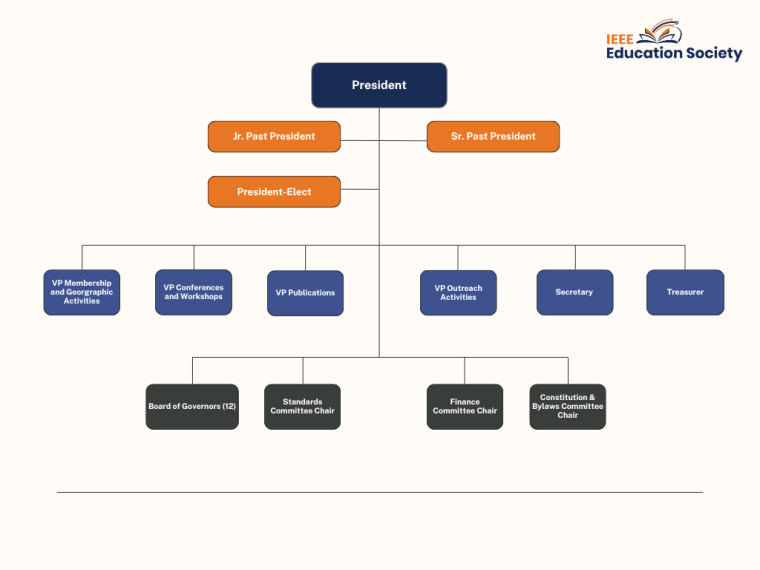
The Education Society’s “mission” and “vision” statements (section 2.1) were approved by the SPC on June 2019 as well as were determined by the Education Society’s stakeholders (section 2.2). Lastly, these strategies were developed ensuring their alignment with the main references of IEEE strategies (section 2.3), and the organizational chart is shown (section 2.4).
2.1 Vision and Mission Statement
Field of Interest: The theory and practice of education and educational technology involved in the effective delivery of domain knowledge of all fields within the scope of interest of IEEE.
VISION: “The Society strives to be the global leader in engineering education.”
MISSION: “The Society is an international organization that promotes, advances, and disseminates state-of-the-art information and resources related to the Society’s field of interest and provides development opportunities for academic, industry and government professionals”
2.2 Stakeholders
| STAKEHOLDER | CATEGORY | NEEDS |
| students | external |
|
| tenure-track faculty | internal |
|
| tenure-track faculty | internal |
|
| sister societies | external |
|
| early career professionals | internal / external |
|
| other IEEE organizational units | external |
|
| companies related IEEE scopes of Interest | internal / external |
|
| academic administrators | external |
|
| educational policy makers | external |
|
| society chapters | internal |
|
| student branches | internal |
|
2.3 Strategies taken as reference
The template used to describe each Strategic goal has been the following:
- Statement
- Short- or long-term goal
- Stakeholders involved and needs satisfied
- EdSoc organizational chart units involved
- EdSoc President Commitments related and reasons
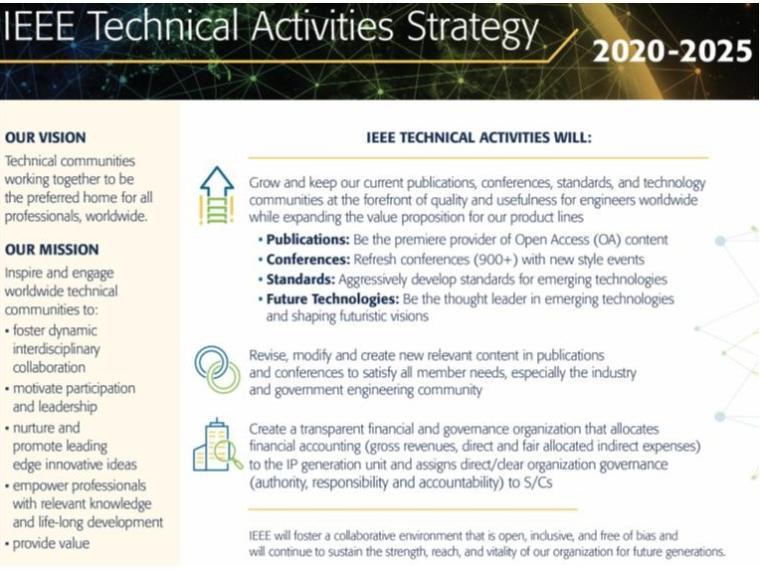
- IEEE TAB 2020-2025 Strategic Goals related and reasons
- IEEE 2020-2025 Strategic Goals related and reasons
Three main sources of strategies were considered:
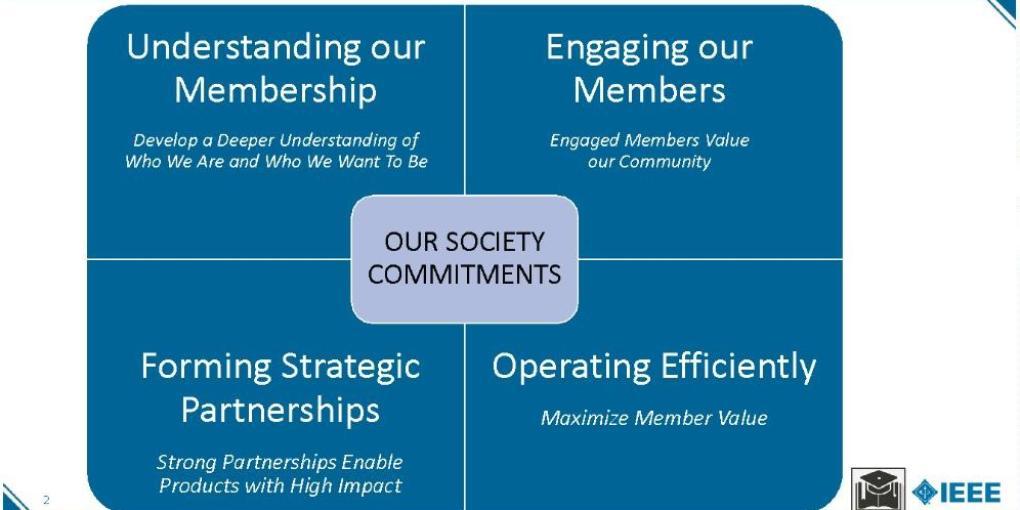
1. Presidential commitments
SPC minutes June 2019
1. Identify Membership Trends and Needs.
- Mine member data for demographics, interest profiles, and trends.
- Evaluate the current product portfolio for usage and interest.
- Concept map a new portfolio of products and services based on needs analysis.
- Initiate a modern product pipeline that maximizes return on investment
2. Engage the Membership.
- Motivate members with a newsletter of thought pieces, information,
and opportunities. - Reinvigorate chapters with a playbook of activities and best practices.
- Initiate active social media channels and user-based.
- Grow three new membership communities through targeted marketing
and products
3. Identify Strategic Partners.
- Partner with other IEEE and non-IEEE OUs to offer products and services.
- Leverage sister society agreements to expand the worldwide reach and
product impact. - Secure long-term corporate sponsorship of awards, scholarships, and products
4. Morph into a lean organization.
- Complete a financial analysis of product portfolio revenue ratios.
- Generate key performance indicator dashboards for all products.
- Reduce expenditures through budget line pruning.
- Increased revenue through product portfolios that encourage continuous
value streams
SPC Minutes October 2019
2. IEEE TAB 2020-2025 Strategic Goals related and reasons
3. IEEE 2020-2025 Strategic Goals related and reasons
4. 2021-2022 Presidential priorities
Externally
- Integrating our policies with those of IEEE
- Maintaining fruitful relationships with OUs
- New Key alliances with other strategic partners and substantiating those alliances we already have.
Internally
- Evolving towards an organization governed by data incorporating them into our decision-making processes
- Action Plan for each initiative, data from TAB
- Empowering the different committees and units of our organizational structure, reviewing their functions, roles and responsibilities
- Developing a process map of the EdSoc and top-level Operational Manual for the Society
- Support the development of Operations Manual for our organizational units and Standing Committees
4.4 Organization
This section provides a brief description of an organizational chart (as of 2021).